


kategória
szerző
cím
sorozat
betöltés...
kiadó
betöltés...
ISBN
évszám
ár
-
leírás
Előrendelhető
A mezők bármelyike illeszkedjen
A mezők mind illeszkedjen



The Legacies of Communism in Eastern Europe [antikvár]
Bennett Kovrig, Ivan Volgyes, Jane L. Curry, Völgyes Iván

PREFACE
Frankly speaking, undl the late 1980s most students of Eastern Europe never thought that a book such as this would be written during our lifetime. Like most political scientists specializing in East European affairs, we merely dared to dream of the end of Communist rule in the region. In fact, as the 1980s wore on, only a very few of us who thought that the end of communism was near were bold enough to confide to anyone the conclusions we were forced to draw from events taking place in the Soviet Union and in Eastern Europe. Were we...
online ár:
Webáruházunkban a termékek mellett feltüntetett fekete színű online ár csak internetes megrendelés esetén érvényes.
8800 Ft

Részletesen erről a termékről
Bővebb ismertető
PREFACE
Frankly speaking, undl the late 1980s most students of Eastern Europe never thought that a book such as this would be written during our lifetime. Like most political scientists specializing in East European affairs, we merely dared to dream of the end of Communist rule in the region. In fact, as the 1980s wore on, only a very few of us who thought that the end of communism was near were bold enough to confide to anyone the conclusions we were forced to draw from events taking place in the Soviet Union and in Eastern Europe. Were we perhaps afraid of being labeled "hopeless optimists," or "congenitally anti-Communist cold warriors"? This may have played a part in our hesitation, but only a part. Our hesitation was in greater measure simply due to the fact that we were trained as observers and not as predictors of human events; although we saw the signs of the disintegration of the power of the USSR, and hence the rapidly approaching end of Communist rule in Eastern Europe, most of us instinctively shied away from prophesying.
And yet, when communism fell, most of us who have labored in the vineyards of Communist studies immediately sensed that we needed to place the system we had observed for several decades under the microscope of scientific observation one last time. We were all convinced that we had to take a slice in time and space of the remains of communism, before change altered Eastern Europe once and for all. It was not a professional autopsy that we wanted to perform; rather, we wanted to take a final glimpse of the legacies that communism left behind. It is this desire for that last, long look, a desire for an intellecmal snapshot of the situation after the collapse, but before the people and the nations started to crawl out of their shelters, that brought us together to write a book on the legacies of communism.
The result is the volume you are now holding in your hands. It is not a book of "readings" in the traditional sense, for we tried to adhere rigorously to the analytic framework oudined in the introductory chapter. Nor is it a book of theoretical essays on the structural problems of the region, for we tried to examine the concrete legacies of the failed system. And finally, it is not a country-by-country litany of woes; although we deal with each formerly Communist East European state, the chapters provide the authors with an opportunity to discuss the legacies of Communism from a comparative perspective.
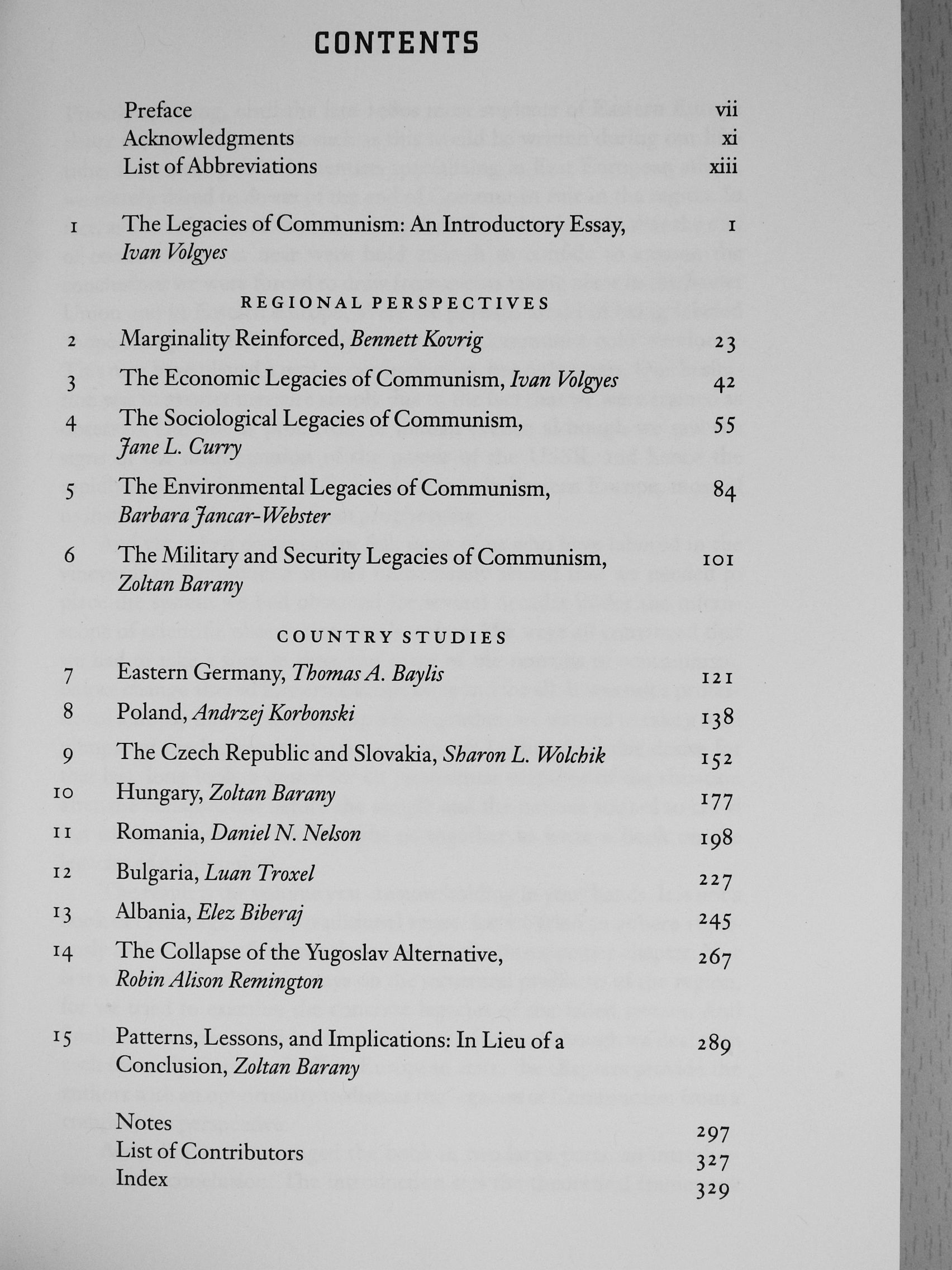
Accordingly, we arranged the book in two large parts, an introduction, and a conclusion. The introduction sets the theoretical framework
Termékadatok
Cím: The Legacies of Communism in Eastern Europe [antikvár]
Kötés: Ragasztott papírkötés
ISBN: 0801849985
Méret: 150 mm x 230 mm
Új vásárló vagyok!
új vásárlóval indíthatsz rendelést............