


kategória
szerző
cím
sorozat
betöltés...
kiadó
betöltés...
ISBN
évszám
ár
-
leírás
Előrendelhető
A mezők bármelyike illeszkedjen
A mezők mind illeszkedjen




The early years
Son of a Tampere merchant
On November 27th, 1870, the first child was born to the Tampere trading family of Hellsten, and given at baptism his father's names, Johan August. The family was a truly Finnish one, though, and gradually they began to call the boy by the Finnish versions of his Christian names, Juho Kusti, the first being the name by which he was commonly called. Both his parents came from the Province of Hame, his father Johan August's ancestors from the village of Orivesi and his mother Karolina Selin's family...
online ár:
Webáruházunkban a termékek mellett feltüntetett fekete színű online ár csak internetes megrendelés esetén érvényes.
4980 Ft

Részletesen erről a termékről
Bővebb ismertető
The early years
Son of a Tampere merchant
On November 27th, 1870, the first child was born to the Tampere trading family of Hellsten, and given at baptism his father's names, Johan August. The family was a truly Finnish one, though, and gradually they began to call the boy by the Finnish versions of his Christian names, Juho Kusti, the first being the name by which he was commonly called. Both his parents came from the Province of Hame, his father Johan August's ancestors from the village of Orivesi and his mother Karolina Selin's family from Lempaala. Juho Kusti lost both his parents at an early age, his mother at four and his father at thirteen.
The Tampere countryside, with its lakes and ridges, was the setting in which he wandered as a boy, and this environment obviously left more lasting marks on his innermost character than the streets and courtyards of industrial cities. At an early age Juho Kusti was moved by a desire to get below the surface of things, to find out the workings of nature. When he learnt to read, he started to search in books for answers to the questions that filled his mind, not only facts about nature, but also the truth about everything else around him. Even in these early childhood years, he became not only a booklover, but also a keen and systematic user of reference works.
When his father moved and set up business in the Hollola district of the newly chartered town of Lahti, this fastgrowing trading and industrial centre became Juho Kusti's new home and remained so for over a decade. Soon, though, his father died, and his aunt Kaisa Hagman, a dealer in dress materials, offered the boy a home and ensured that the schooling he had started while his father was still alive could go on.
Hameenlinna Lyceum
In 1882 Juho Kusti joined the first class at Hameenlinna Lyceum, a school that can claim to have moulded the early years of many distinguished figures in Finnish society. The talented teachers at this school gave him not only a good theoretical grounding but also a splendid training for civic life, and above all a feeling of firm affinity with Finnish nationalism. One indication of this latter trait is that in 1885, when he was only 15, he adopted the Finnish surname Paasikivi.
Young Paasikivi took an active part in the communal life of the school, acting, for instance, as leader of the convention choir. In spring 1890 he matriculated, with a brilliant performance not only in the compulsory subjects, but also in all the voluntary translation papers in foreign languages. He was a school-leaver much talked of in contemporary social and school circles in this well-known educational town.
Academic life
In autumn 1890 Paasikivi registered with the Hame Student Union at Helsinki University and began his studies in the Department of History and Linguistics. He completed his degree — Candidate of Philosophy — in only two years, with a "lauda-tur" in Russian language and literature, "cum laude approbatur" in Finnish, Russian and Scandinavian history, and in philosophy, and "approbatur" in Roman literature and botany. The choice of Russian as main subject was unusual, as only eight students offered it in the Candidate's examination between 1883 and 1906. Thus, even at this early stage, Paasikivi was laying the foundation for the knowledge of Russian that was later to be so vital to him. In later years he also improved his grading in two other subjects to "laudatur" level, i.e. in February, 1893, in philosophy and in June the same year in history. Thus Paasikivi's Candidate's degree, originally taken so rapidly, was brought up to a really high standard-
Like several other jurists aiming at a scholar's career, Paasikivi made his history studies and his Candidate of Philosophy degree in general a basis for study of the law. He began this in 1892 and graduated as Candidate of both civil and criminal law in 1897.
In spite of his hectic study pace over these years Paasikivi also worked for the foreign department of the newspaper Uusi Suometar, one of his jobs being night desk proof-reader. He took an active part in the student life of his Union in popular education and as a regular singer in the Student Choir. At one stage he was being considered as director of this choir, but "I recognized my own limitations in time," he later related with a twinkle.
Paasikivi spent part of the term in Lahti. It was from there that he wrote, in May 1893, to Professor
Termékadatok
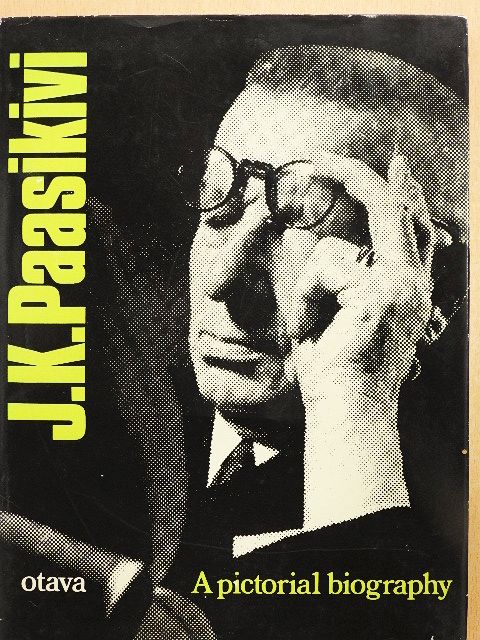
Cím: J. K. Paasikivi [antikvár]
Szerző:
Uuno Tuominen
Kiadó: The Otava Publishing Co.
Kötés: Vászon
Méret: 190 mm x 250 mm
Új vásárló vagyok!
új vásárlóval indíthatsz rendelést............